AIRTuB in the news: robots for offshore wind turbine inspection
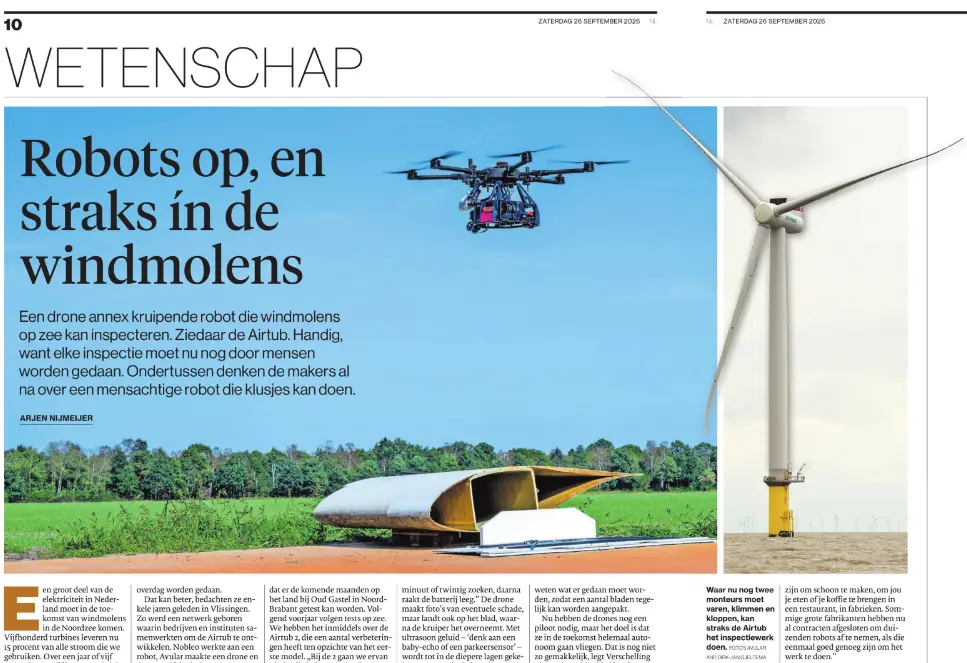
Dutch newspaper Algemeen Dagblad (AD) recently featured AIRTuB, a project exploring how drones and robotics can change the way offshore wind turbines are inspected and maintained. Nobleo is one of the partners contributing to its development.
As the number of wind turbines in the North Sea continues to grow, so does the need to inspect and maintain them. And at sea, even a seemingly straightforward inspection can be quite an operation.
From abseiling to robotic inspection
Today, inspecting a wind turbine blade still involves a lot of manual work. Specialists travel to the turbine by boat, climb it and abseil down the blades to look for signs of damage. AIRTuB explores a different approach.
The system combines a drone with a small crawling robot. The drone can fly to a turbine blade and land on it. From there, the crawler takes over and inspects the blade for damage. This could allow inspections to be carried out more frequently while reducing the need to send specialists offshore for every inspection.
A collaboration across disciplines
Getting a drone to land on a wind turbine blade, and a robot to move across it and inspect it, brings together expertise from many different fields. AIRTuB has therefore been a collaborative effort from the start. Nobleo has been working on the crawler and the autonomy behind the system, alongside partners including Avular, TU Delft and many others. The AIRTuB project is coordinated by World Class Maintenance within Fieldlab Zephyros. Each partner brings a different piece of the puzzle, from robotics and drone technology to sensing and inspection.
What is next?
The current AIRTuB system is still being developed and tested, but the ambitions go further. As Jeroen Verschelling of Zephyros explains in the AD article, future versions are expected to become smaller and increasingly autonomous. The team is also looking ahead to robots that could eventually do more than inspect a blade and carry out minor repairs themselves.
And the thinking does not stop at turbine blades. The article also looks at how other types of robots, including humanoid robots, could one day support maintenance work inside offshore wind turbines.
Outsmarting tomorrow, together
AIRTuB shows how robotics can be applied to a very practical challenge: work that currently requires people to travel offshore, climb turbines and operate in demanding conditions.
There is still plenty to develop and test before these systems can take over more of that work. But that is exactly what makes projects like AIRTuB interesting: bringing people, disciplines and technologies together to find out what can be done differently tomorrow.
Read the full story in Algemeen Dagblad (AD).