

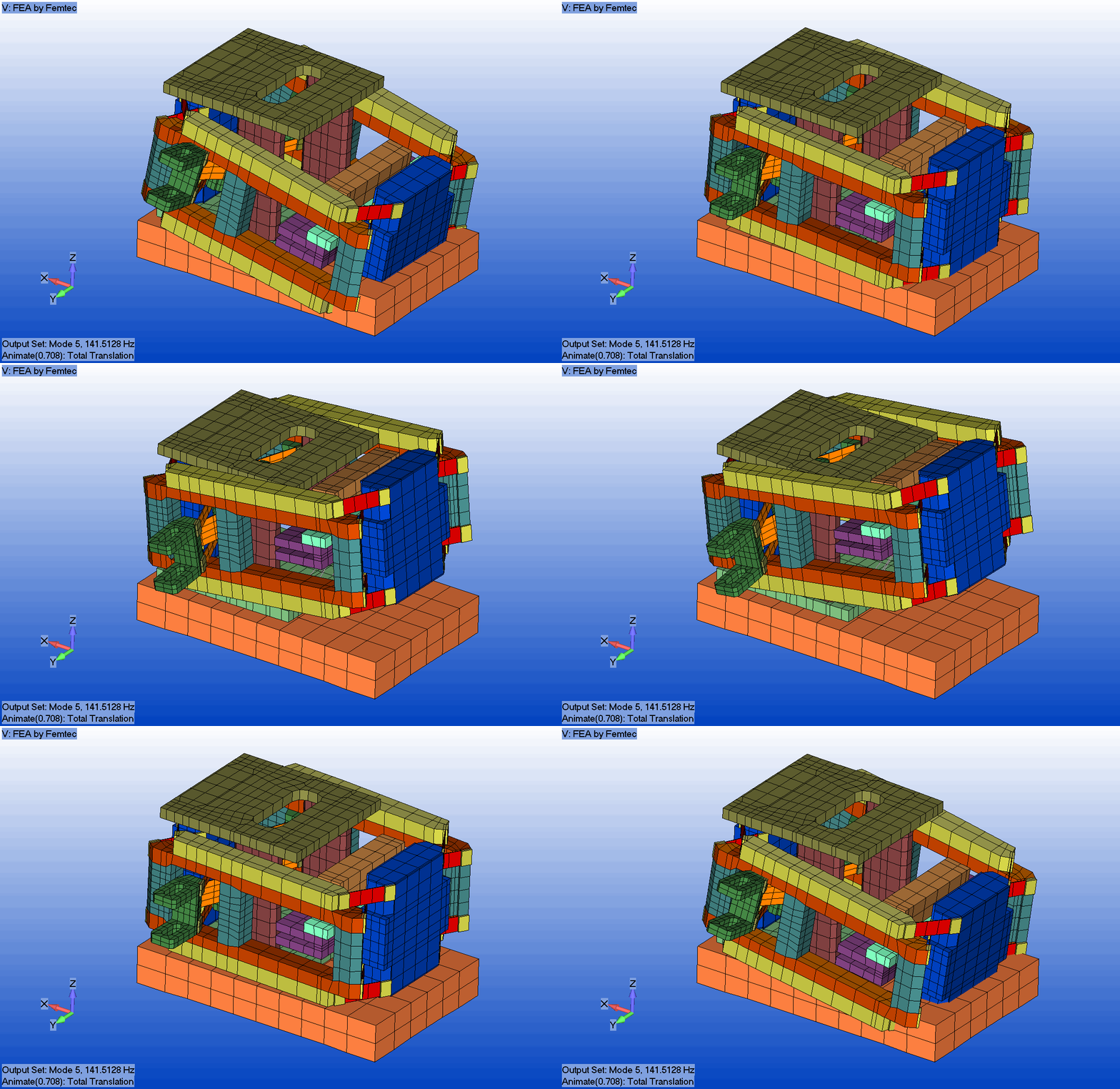
Prevent costly redesigns and validate high-tech system performance before you build. Structural, dynamic and thermal behaviour often determine whether a system meets its performance requirements. Our Finite Element Analysis (FEA) expertise provides early-stage insight into these effects, supporting informed design decisions, risk reduction and efficient validation. Applied across high-tech industries, from concept development to design optimisation and verification.
Finite Element Analysis for robust and predictable system performance
Nobleo designs complex high-tech systems that must perform reliably in challenging environments. Finite Element Analysis (FEA) is an important part of our modelling approach, enabling us to meet demanding system requirements while improving accuracy, repeatability and robustness.
Designing advanced mechatronic modules requires clear insight into system behaviour to predict and ensure performance. By identifying critical design drivers early, FEA supports efficient optimisation and fast-focused redesign throughout the development process.
Effects such as floor- and flow-induced vibrations, structural loads and thermal influences impact system performance and lifetime. Understanding and mitigating these effects is needed to ensure durability and compliance with specifications.
Verification and validation through simulation
Using FEA, we model and analyze system behavior to identify dominant compliances, understand how deformation propagates through the structure, and evaluate how mass distribution affects dynamic behavior.
We apply a wide range of analyses, including structural, modal, harmonic, and random vibration analysis, as well as thermo-mechanical simulations and thermal analysis in both steady-state and transient conditions. These analyses enable us to assess system stiffness, stability (including buckling), thermal performance, and lifetime under realistic operating conditions.
FEA also supports mass optimization, allowing us to redesign mass distribution to improve dynamic performance and reduce sensitivity to vibrations. By identifying performance issues early in the simulation phase, we iterate on the design and implement targeted improvements. This reduces the risk of costly redesigns and project delays.
Integrated system approach
By making dynamic and thermo-mechanical behavior explicit and quantifiable, FEA enables us to close the loop between mechanical design, system dynamics, and control engineering. It acts as a bridge between design and control teams, supporting efficient collaboration and faster convergence towards an optimal design.
Within Nobleo this core structural and Multiphysics tool is embedded in the Nobleo Design Core. It is applied throughout the product development process to ensure robust, predictable, and high-performance systems that meet both functional and lifetime requirements.
Key disciplines in our approach
Structural Analysis
Linear and non-linear structural analysis for stiffness, deformation, stress and stability assessment.
Dynamic Analysis
Modal, harmonic, random vibration and frequency response analysis.
Thermal & Thermo-Mechanical Analysis
Steady-state and transient thermal simulations combined with structural response evaluation.
Stress Evaluation
Assessment using principal stress and Von Mises stress evaluation methods.
Strength & Durability Assessment
Evaluation of structural integrity, stability and lifetime performance under operational conditions.
Verification & Validation
Simulation-driven assessment of system behaviour throughout development.
Asset
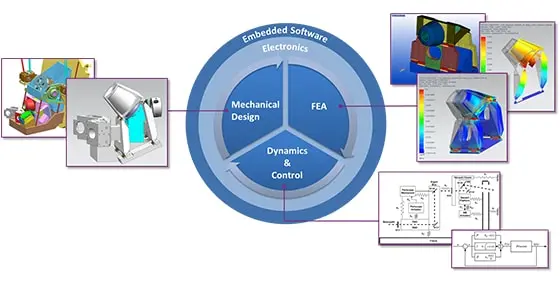
Nobleo Design Core
FEA is embedded in the Nobleo Design Core and applied throughout the product development process to support robust, predictable and high-performance system development.
Industries we serve with our finite element analysis expertise
- Semiconductor
- Healthcare
- Industrial systems & automation
Applications of our finite element modeling expertise
- Structural verification of critical components and assemblies
- Dynamic performance evaluation of precision systems
- Floor-induced vibration analysis
- Flow-induced vibration analysis
- Thermal stability assessment
- Thermo-mechanical performance evaluation
- Frequency response analysis
- Mass distribution optimisation
- Strength and durability assessments
- Design verification and validation



Get in touch
"*" indicates required fields
Trusted by industry leaders





Frequently Asked Questions
What types of engineering challenges can Nobleo Technology solve with Finite Element Analysis (FEA)?
Finite Element Analysis helps solve engineering challenges related to structural loads, vibrations, thermal behaviour and dynamic performance. We use FEA to evaluate stiffness, deformation, stability, thermal effects and lifetime performance, helping customers develop robust, predictable systems that meet demanding performance requirements.
When should Finite Element Analysis be applied during product development?
Finite Element Analysis delivers the greatest value when applied early in the development process. By analysing structural, thermal and dynamic behaviour before hardware is built, potential performance issues can be identified and addressed before they result in costly redesigns. FEA also supports optimization and verification throughout later design stages.
How does Finite Element Analysis help reduce costly redesigns?
FEA allows potential performance limitations to be identified during the simulation phase rather than after physical prototypes have been built. By evaluating different design concepts early, we can optimize critical design parameters, reduce technical risks and minimize the need for redesign later in the development process.
How does Nobleo Technology decide which types of FEA simulation is needed?
The choice of FEA simulation is driven by the engineering question being addressed. Depending on the product requirements and operating conditions, we may perform structural, modal, vibration, thermomechanical or fatigue analyses. By selecting the most relevant simulation approach, we can focus on the factors that have the greatest impact on system performance, reliability and durability, helping guide design decisions with confidence.
Can Finite Element Analysis predict thermal and vibration behaviour before a prototype is built?
Yes. Finite Element Analysis enables us to model how a system responds to thermal loads, structural forces and dynamic excitation before physical hardware is available. These simulations provide valuable insight into expected system behaviour and support informed design decisions early in development. This helps reduce the need for costly design iterations and increases confidence in system performance before prototyping.
How does Finite Element Analysis support verification and validation?
FEA provides simulation-based insight throughout product development by predicting how a design is expected to perform under realistic operating conditions. These simulation results support verification of the design and help validate whether the system is likely to meet its functional. Structural and lifetime requirements before physical testing begins.
Can Finite Element Analysis be used to improve existing designs as well as new developments?
Yes. FEA is valuable both for new product development and for improving existing designs. Whether the goal is to increase stiffness, reduce vibration sensitivity, optimize mass distribution or improve thermal performance, simulation helps identify targeted design improvements while reducing development risks.