How Nobleo accelerates Robotics Development with NVIDIA Isaac Sim
Developing advanced robotics and autonomous systems is becoming increasingly complex. Companies are expected to develop faster, reduce risks and validate systems earlier in the development process. Robotics simulation is becoming an important way to support that shift, helping engineering teams explore critical scenarios virtually, generate synthetic training data and validate systems more efficiently, either before or simultaneous to physical testing. With NVIDIA Isaac Sim, Nobleo Technology helps customers integrate simulation into practical engineering workflows, enabling them to develop better prepared, with fewer unknowns and more focused test scenarios.
Why robotics simulation is growing
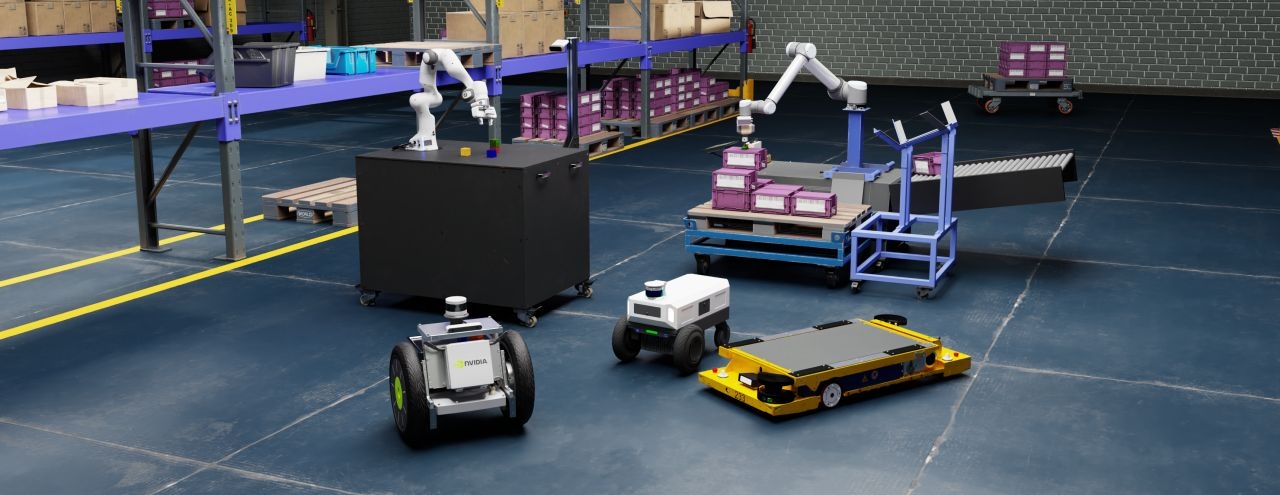
As robotics systems become more autonomous, development teams need ways to test behaviour in environments that are difficult, expensive, or unsafe to recreate physically. NVIDIA Isaac Sim is a robotics simulation platform built on NVIDIA Omniverse technology. “With Isaac Sim we can create high-fidelity digital twins of robots, sensors and various environments and scenarios,” says Bram Odrosslij, Robotics and AI Engineer at Nobleo Technology. “Within these virtual environments, we can then test robot behaviour, validate or train AI models, create digital test environments and generate sensor data.”
For companies developing robotics systems, simulation adds value at every stage of the development process. During early development, it reduces dependency on physical prototypes, allowing teams to iterate faster and identify issues before building or deploying hardware. According to Bram, this is particularly valuable when physical testing is costly or operationally risky. “Some scenarios are simply difficult to reproduce consistently in reality,” he explains. “With virtual testing, we can safely explore sensor behaviour and failure scenarios long before a robot enters production or field testing.” But the benefits extend further. Even when a robot is already being physically tested, simulation can play a role. “Virtual environments can also run in parallel to physical testing to identify edge cases, simulate unique failure modes and collect training data for vision or control networks,” Bram adds.
Digital twins for realistic validation
Digital twins become particularly valuable when validating robotics systems in complex and dynamic operational environments. “These twins can replicate factories, warehouses, agricultural systems, cleanrooms, and other operational settings in which robots need to function reliably,” Bram explains. “Physics-based simulation and realistic rendering allow us to study how robots interact with their environment under varying conditions. The same simulation environments can also be used for realistic operator training, allowing teams to safely practise complex procedures.”
Nobleo recently applied this approach using Isaac Sim in a project involving operator training for a large crane used for lifting wind turbine nacelles. “Because physical training comes with considerable costs and risks, we created a virtual representation of the system using CAD data, integrating realistic controls and camera perspectives. Thus, allowing operators to practise complex manoeuvres in a realistic simulation environment before using the physical installation.”
Synthetic data generation for robotics
Modern robotics increasingly relies on AI models that interpret camera feeds, LiDAR data, and other sensor inputs. Training these models requires large amounts of high-quality data. “That data simply doesn’t exist at the scale robotics needs,” Bram says. “And in many robotics applications, collecting sufficient real-world data is difficult, time-consuming, and expensive. Simulation allows us to generate synthetic data that helps train robotics AI and machine vision systems much more efficiently.”
Isaac Sim supports synthetic data generation by creating simulated sensor outputs within photorealistic virtual environments. Lighting conditions, object positions, reflections, weather effects, system dynamics, and environmental variables can be adjusted automatically to generate diverse datasets. This is especially useful for robotics perception systems that need to remain robust under changing operational conditions. “If a robot only learns from limited field data, performance can quickly degrade when conditions change,” Bram explains. “Synthetic data helps engineering teams expose AI models to far more variation than would be practical during physical testing alone.”
Nobleo as your simulation engineering partner
What makes simulation-first development effective is not the simulation platform itself, but the engineering decisions built around it. That is where Nobleo adds value. Rather than treating Isaac Sim as a standalone tool, Nobleo integrates simulation into a broader robotics development workflow that connects virtual testing to physical engineering challenges. “By combining expertise across multiple engineering domains within a single development approach, we help customers translate simulation outcomes into robust and reliable real-world systems,” Bram says.
From modelling robots, sensors, and operational environments to integrating simulations with existing ROS 2, AI and control software, Nobleo focuses on building simulation workflows that are technically relevant and practically useful. “We are not positioning Isaac Sim as a standalone tool,” Bram explains. “The real value comes from translating a customer’s engineering challenge into a practical simulation workflow that supports better technical decisions. This includes building robot and sensor models, configuring realistic environments, defining representative test scenarios, and connecting simulation outputs to physical system development.”
Supporting the next generation of physical AI
Bram expects simulation-first development to play an increasingly important role as robotics systems become more adaptive and capable of operating in less structured environments. “We are moving beyond robots that simply repeat fixed tasks,” he says. “Future systems will need to respond to changing situations, interact more intelligently with their surroundings and make decisions based on far more complex sensor input.” According to Bram, that shift will place growing pressure on engineering teams to validate behaviour earlier and under a much wider range of conditions than would be feasible through physical testing alone.
This development is already creating new opportunities across sectors where robotics and autonomous systems are becoming more advanced, including industrial automation, logistics, agriculture, healthcare, and high-tech manufacturing. As these systems continue to evolve, simulation environments can help engineering teams better understand system behaviour, explore edge cases, and prepare AI-driven robotics for deployment in the field with greater confidence.
Talk to Nobleo about robotics simulation
Whether companies are exploring digital twins, synthetic data generation or virtual training environments, the goal remains the same: creating solutions that perform reliably outside the simulation as well. Interested in exploring what simulation-first development could mean for your robotics or autonomous systems project? Nobleo can help you assess where simulation adds value in your robotics or autonomous systems development workflow. Fill out the contact form below to talk with us about your challenge.